What is a Bolt on Balcony?
The Deck And Railing Source
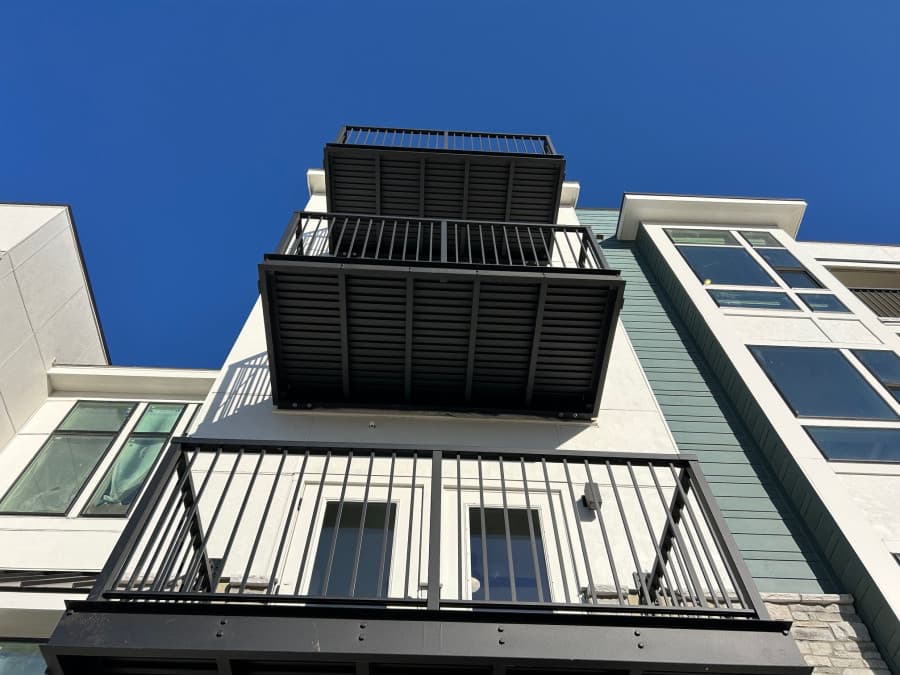
A bolt-on balcony is a fully engineered, prefabricated structural system designed to attach to a building using mechanical fasteners and engineered connection assemblies. While often described simply as “prefab balconies,” modern bolt-on systems are highly technical structural components that integrate with architecture, structural engineering, and long-term building performance.
1. Connection Engineering & Structural Interfaces
The most critical element of a bolt-on balcony is the connection assembly. This is where engineering precision matters most.
Common Attachment Methods:
- Embedded steel plates cast into concrete slabs
- Through-bolt assemblies with structural backing plates
- Knife plate connections welded to structural steel frames
- Ledger-style attachments into reinforced wood framing
These connections are engineered to resist:
- Vertical shear forces
- Bending moments
- Torsional loads
- Lateral movement
- Wind uplift
Proper structural detailing ensures loads are transferred safely into the building’s primary framing system — not just the façade.
2. Drainage & Water Management
Proper drainage is essential to balcony longevity and building performance. Modern bolt-on systems often incorporate:
- Sloped structural framing
- Integrated drainage trays
- Drip-edge detailing
- Flashing at attachment points
- Gutter or downspout systems where required
By separating the balcony from the building’s structural slab, moisture exposure risks are better controlled. This reduces the long-term likelihood of water infiltration, slab deterioration, and envelope-related failures commonly seen in traditional cantilevered concrete balconies.
3. Modular & Stacked Configurations
Bolt-on balconies are frequently designed in stacked vertical alignments for multi-story buildings. This configuration offers:
- Direct structural load alignment
- Repetition for manufacturing efficiency
- Streamlined crane installation sequencing
- Consistent architectural rhythm
For large-scale developments, entire elevations may be designed with modular balcony stacks, allowing rapid installation across dozens or hundreds of units. This modularity significantly improves scheduling predictability.
4. Material & Finish Options
Structural Frame Options:
- Hot-dip galvanized steel (maximum corrosion resistance)
- Powder-coated structural steel (architectural finish flexibility)
- Architectural aluminum (lightweight and corrosion-resistant)
Guard & Infill Systems:
- Aluminum picket railings
- Framed glass guard systems
- Topless (base shoe) glass systems
- Perforated metal panels
- Composite or aluminum privacy screens
Decking Surfaces:
- Aluminum plank systems
- Composite decking
- Porcelain or concrete pavers
- Fiberglass grating
- Waterproof membrane systems
This flexibility allows architects to achieve aesthetic goals while developers standardize structural platforms for efficiency.
5. Construction Timeline Impact
From a construction management standpoint, bolt-on balconies offer significant schedule advantages:
- Fabrication occurs off-site in parallel with structural framing
- No slab extensions or additional formwork required
- No concrete curing delays
- Reduced on-site labor coordination
- Faster overall project turnover
Installation is typically performed using a crane and a small crew. In many cases, a balcony can be installed in a matter of hours, allowing multiple units to be completed in a single day.
6. Retrofit & Structural Reinforcement
Bolt-on balconies are particularly valuable in retrofit applications. Engineers can design attachment methods for existing structures through:
- Reinforced slab edge connections
- Added structural steel support frames
- Supplemental vertical support columns (where required)
This enables property owners to add outdoor living space to older buildings without full structural reconstruction — increasing property value and tenant appeal.
7. Lifecycle & Maintenance Advantages
Compared to traditional cantilevered concrete balconies, bolt-on systems often provide:
- Reduced cracking and spalling risk
- Easier inspection access
- Replaceable structural components
- Simplified long-term maintenance
If necessary, individual balcony units can sometimes be removed and replaced independently, minimizing disruption to the building structure.
8. Code Compliance & Safety
Bolt-on balconies are engineered to comply with:
- Local and national building codes
- Required live load standards
- Guard height and concentrated load requirements
- Wind and snow load criteria
- Fire separation regulations where applicable
Stamped engineering drawings are typically provided for each project to ensure full structural compliance prior to installation.
9. Economic & Market Impact
From a development perspective, balconies serve as both a structural feature and a revenue driver. They contribute to:
- Higher rental premiums
- Increased resale value
- Greater unit desirability
- Competitive differentiation in dense markets
- Improved tenant satisfaction
In multi-family and mixed-use developments, private outdoor space often plays a key role in leasing performance and long-term asset valuation.
Final Perspective
A bolt-on balcony is a precision-engineered structural solution that enhances architectural flexibility, accelerates construction timelines, and improves long-term building performance. By manufacturing the system off-site and installing it through engineered connections, developers gain efficiency, contractors gain predictability, and property owners gain lasting value.
Comments(0)